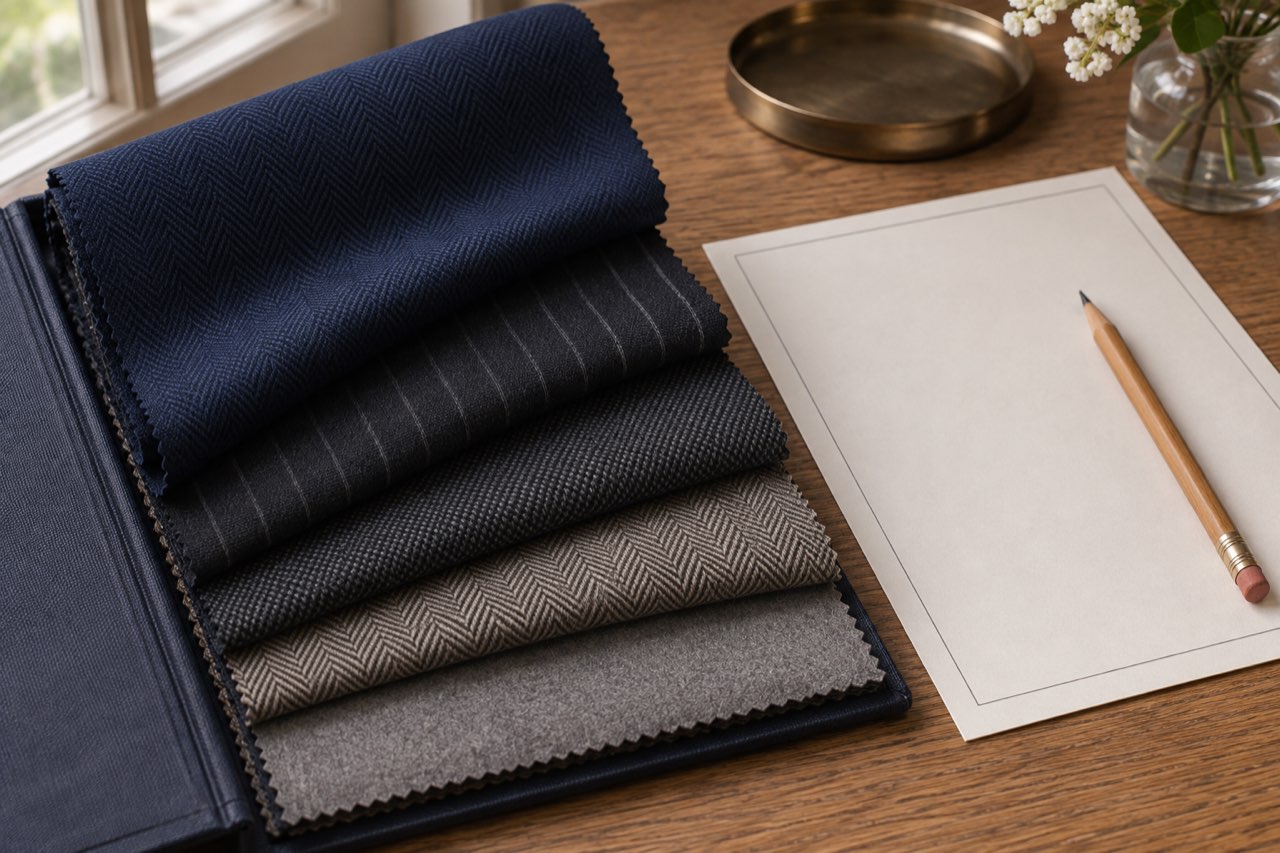
Copy four things from the swatch onto the order: the mill or merchant, the bunch name, the cloth reference exactly as printed, and the colour. A mill name by itself can point to well over a hundred cloths, and the reference is what ties the length we cut to the swatch your client held in your shop.
Why is the mill name not enough?
Take Zegna. Our Shanghai shelves carry 162 Zegna styles: 99 from the Trofeo book and 63 from the Traveller book. An order line that reads "Zegna, navy" could match many of them. Navy turns up in both books, in more than one weight and more than one weave, and a plain navy and a navy with a faint stripe can look alike from across a counter, so the line tells us the colour family and not much else. Every question that goes back to you adds time, and your client is the one who waits for the suit.
So we stop and ask.
Scale that across the range. Our cloth list runs to 33 mills and cloth merchants. 26 are European, and the bigger houses run several books side by side. Some bunches come back year after year under the same name while the cloths inside change. The reference printed on the swatch is the one detail that survives all of that.
Four details from the swatch
Open the bunch at the swatch your client picked and look at the label on the swatch and at the selvedge strip, if the swatch has one.
Mill or merchant
Write the name that appears on the swatch. Sometimes that is a mill, sometimes a merchant that buys woven cloth from mills and puts its own name on it. If the swatch carries a merchant's name, use the merchant's name, even when you know which mill wove it. We order from whoever is named on the swatch.
Bunch name
The bunch is the book the swatch sits in: Trofeo, Traveller, Four Seasons, and so on. It cuts the search from a whole mill down to one book. That still leaves dozens of swatches, so it does not replace the reference.
Cloth reference
This is the code on the swatch label. Copy it character for character, with every slash, dot, space and leading zero in place. A reference with a slash and the same digits with a hyphen can be two different cloths, and one wrong digit can send a cloth nobody asked for to the cutting table.
Colour
Write the colour as the swatch shows it, as a name, a number, or both if both are printed. Some mills fold the colour into the reference and some print it separately. If you are not sure which kind you have, write what you see and let us sort it out.
Held and special order cloth together
Most of what we cut comes off our own shelves in Shanghai: the Zegna books above, a Vitale Barberis Canonico Four Seasons book, and our house book. Some names we never hold. Söktaş and Ariston, both merchants, are special order only, as is Loro Piana, and we order that cloth in against a confirmed job.
An order can carry both kinds. Write the same four details for every line, and mark the special order lines so nobody on our side goes looking for them on the shelf. For special order cloth, the mill's or merchant's own lead time comes first, and our 14 days in production start once the cloth arrives. Ask us about timing for that line when you place the order, so you can give your client a date you can keep.
The reference on your order documents
You place orders through our online ordering platform, available in five languages. If a client is in front of you and the order goes to us by WhatsApp instead, put each of the four details on its own line so nothing runs together.
Before you send anything, hold the swatch next to the screen and read the reference back one character at a time. A cut length cannot be put back on the roll. When the label is worn or the print is small, photograph it and send the photo along with the typed reference.
The bunch and the reference then appear on your order documents, which are worth keeping, because if your client ever wants to confirm the cloth with whoever is named on the swatch, those two details are what they will need.
Common copying mistakes
The most common one is a line that names a mill and a colour and stops there. We will ask, and the order sits until you answer.
Next is the neighbouring swatch. Bunches are thick, the swatches are close together, and two neighbours can be the same colour in different weights. If you copy from the page next to the one your client chose, you get a cloth that looks right on paper and feels wrong in the hand. Lay the cutting your client touched next to the label you are copying from.
The last one is writing a reference from memory, or from an old order for the same client. References are filing codes, and they are easy to get almost right. Copy from the swatch every time, even for a repeat order, because the book may have changed since the last one.
What to do next
Pull up your open orders and check that every cloth line carries the mill or merchant, the bunch, the reference and the colour. Fill any gaps before the order reaches us. If you have a swatch you cannot read, or want to know whether a cloth is held or special order, the WhatsApp number is +86 156 1869 3816.